Six centuries of the Orloj
Prague Orloj history: from 1410
How the Prague Orloj began in 1410, who built it, which stories about it are legend, and how it survived 1945 and a major restoration in 2018.
Check tower dates ↗Quick answer
The oldest part of the Prague Orloj, the mechanical clock and astronomical dial, dates from 1410. Wikipedia credits the clockmaker Mikuláš of Kadaň and the Charles University mathematician and astronomer Jan Šindel, with the first recorded mention on 9 October 1410. The calendar dial came around 1490, the Apostles after repairs in 1787–1791, and the clock was repaired again in 1948 and 2018.
1410: the clock and the dial
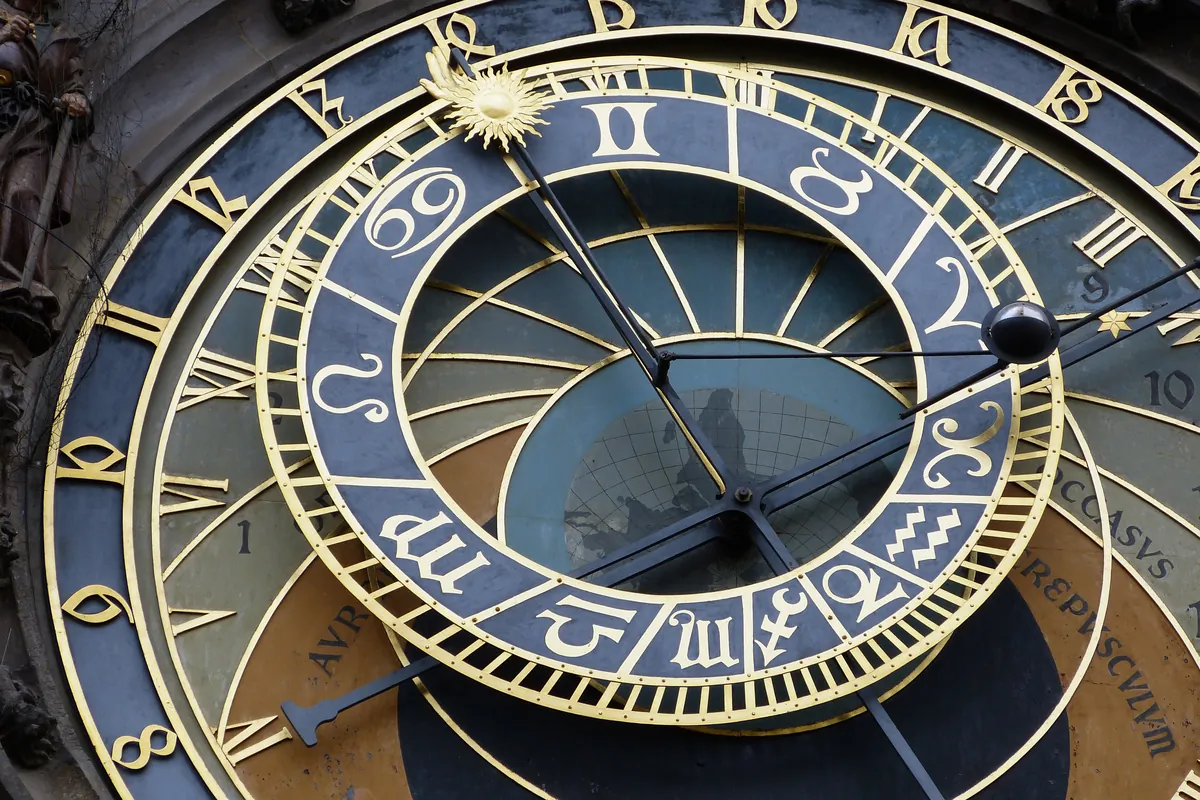
Wikipedia says the oldest part of the Orloj, the mechanical clock and the astronomical dial, dates back to 1410, when it was created by the horologist Mikuláš of Kadaň and Jan Šindel, a professor of mathematics and astronomy at Charles University. The first recorded mention of the clock is dated 9 October 1410. Jan Šindel was rector of the university that same year. The clock was installed on the tower of the Old Town Hall, a tower finished in 1364. Wikipedia's Old Town Square page calls it the oldest astronomical clock still in operation.
The calendar dial and the Gothic frame
Wikipedia says the calendar dial was added presumably around 1490, when the clock's facade was decorated with Gothic sculptures. The lower calendar plate that you see today is a copy made in 1880. The original, by the painter Josef Mánes, is kept in the Prague City Museum. The calendar's edge carries a church calendar with fixed holidays and the names of 365 saints, and its medallions show allegories of the months. Statues of a philosopher, an archangel, an astronomer and a chronicler stand beside it.
The legend of Hanuš, and why historians drop it
For a long time the Orloj was credited to a clockmaster named Jan Růže, called Hanuš, in 1490. Wikipedia says this is now known to be a historical mistake, probably linked to his reconstruction of the Old Town Hall in 1470–1473. A legend recounted by Alois Jirásek says that Hanuš was blinded on the orders of the Prague councillors so that he could not repeat his work, and that he disabled the clock in revenge. This is a legend. The documented repair of 1552 is by Jan Táborský of Klokotská Hora.
Repairs, statues and the Apostles
The Orloj stopped working many times after 1552 and was repaired many times. Wikipedia says wooden statues were added in 1629 or 1659, and that the figures of the Apostles were added after a major repair in 1787–1791. In the repair of 1865–1866 a golden rooster was added, and Josef Mánes painted the calendar dial in 1866. Wikipedia's page on the Old Town Hall says the first version of the clock was finished in 1410, that later reconstructions changed the design completely, and that written records confirm it already had all the basic features.
Read next: Prague Orloj apostles: best viewing
1945 and the long repair
The Orloj suffered heavy damage on 7 and especially 8 May 1945, during the Prague uprising, when the Nazis fired on the south-west side of Old Town Square. The hall and nearby buildings burned, together with the wooden sculptures on the clock and the calendar dial made by Josef Mánes. After significant effort the machinery was repaired, the wooden Apostles were restored by Vojtěch Sucharda, and the clock started working again in 1948. Prague City Tourism adds that the east and north wings of the Old Town Hall, opposite the Týn Church, were destroyed and never rebuilt.
2005, 2010 and 2018
The Orloj was renovated in autumn 2005, when the statues and the lower calendar ring were restored. On 9 October 2010, its 600th anniversary, a light show with two projectors was shown on the face of the clock tower. From January to September 2018 the clock was taken down, a screen stood in its place, and an electric mechanism that had been running since 1948 was replaced by an original mechanism from the 1860s. The restored Orloj resumed operation on 28 September 2018. In 2022 the restored calendar painting became the subject of a heritage dispute, which Wikipedia describes in some detail.
Frequently asked questions
Who built the Prague Orloj?
Wikipedia credits the clockmaker Mikuláš of Kadaň and Jan Šindel, a Charles University professor, with the clock and astronomical dial of 1410.
When is the first record of the clock?
The first recorded mention is dated 9 October 1410, according to Wikipedia.
Did a clockmaker named Hanuš build it?
That is a legend. Wikipedia says the attribution to Hanuš is now known to be a historical mistake.
Did the clock survive the Second World War?
It was badly damaged in May 1945, repaired and running again in 1948.
Sources